The Aaron E. Norman Fund begins a decades-long commitment to the NAACP and its Legal Defense Fund.
When then-deputy director of the NAACP Legal Defense Fund Jack Greenberg reflected on the organization’s funders in the early 1950s, he recalled that philanthropic support was scarce and modest. As he put it: “A big contribution was $100, and $1,000 was a tremendous gift…A few smaller foundations like Field and New York and, soon, Norman contributed as early as the 1950s.”
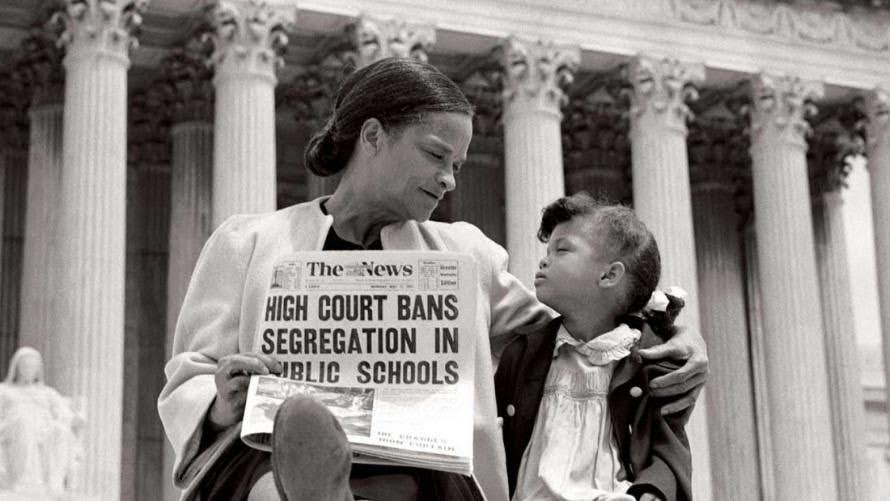
The NAACP (Norman grantee 1952–1956) — the National Association for the Advancement of Colored People — was founded in 1909 and played a critical role in the Civil Rights Movement, combining legal strategy, political advocacy, and grassroots mobilization to dismantle racial segregation and discrimination in America. In 1954, its Legal Defense Fund, led by Thurgood Marshall, won a landmark civil rights victory: the Supreme Court’s unanimous ruling in Brown v. Board of Education that racial segregation in public schools was unconstitutional. The decision dismantled the legal foundation of Jim Crow by overturning the “separate but equal” precedent established by Plessy v. Ferguson, which legitimized segregation for nearly 60 years.
In 1957, when the NAACP Legal Defense and Educational Fund (Norman grantee 1957– 1986) formally spun off from the NAACP as its own independent organization, Norman’s grants followed — supporting LDF’s expanding civil rights docket through the 1960s, funding its Municipal Equalization Project in the 1970s to challenge the discriminatory delivery of public services in Black communities across the South, and backing its voting rights litigation in the 1980s to protect and expand the right to vote for communities of color. Over more than thirty years, Norman’s cumulative grants to the NAACP and its Legal Defense Fund exceeded $150,000 — a sustained commitment that supported the arc of the Civil Rights Movement.
Media:
- CBS Sunday Morning: These United States – Brown v. Board of Education