The New York Civil Liberties Union and the Center for Third World Organizing respond to a national reckoning on police violence.
The assault of Rodney King by Los Angeles police officers in 1991 — captured on video and broadcast around the world — and the uprising that followed the acquittal of those officers in 1992, forced a long-overdue national conversation about police violence, racial injustice, and the lack of meaningful accountability for law enforcement. The Norman Foundation supported two grantees’ projects focused on community safety and accountability:
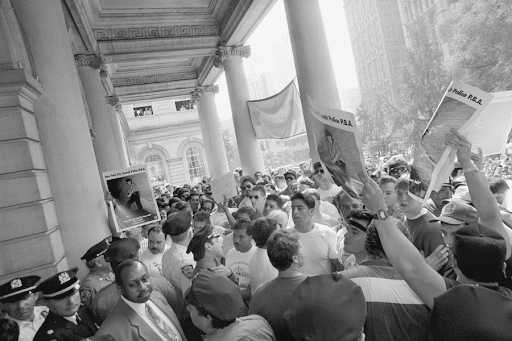
The New York Civil Liberties Union (NYCLU, Norman grantee 1974–1984, 1992–1995) had long documented patterns of police misconduct and abuse among New York City’s communities of color, who bore the brunt of excessive force with little recourse for restitution. Through its Police Accountability Project, the NYCLU pushed for independent civilian oversight of the NYPD, a fight that met fierce resistance from within the department itself. In 1992, hundreds of off-duty NYPD officers rioted at City Hall in response to Mayor David Dinkins’ proposal to strengthen civilian oversight — an extraordinary display of institutional resistance to accountability. NYCLU would prevail later that year: the New York City Council mandated an independent Civilian Complaint Review Board that began operating in July 1993, creating a permanent mechanism for New Yorkers to challenge police misconduct.
The Center for Third World Organizing (CTWO, Norman grantee 1993–1998, 2015–2022) brought a complementary approach to addressing police misconduct. Founded in 1980 in Oakland, CA, CTWO pioneered a new model of community organizing that trained youth of color, built multiracial coalitions, and incubated grassroots organizations across the country. Its Campaign for Community Safety and Police Accountability worked to build community power as a counterweight to unchecked law enforcement, organizing residents most directly impacted by police violence to demand systemic change from the ground up.
Together, the two organizations embodied a two-pronged approach to a single urgent problem: NYCLU working through legal advocacy and institutional reform, CTWO through grassroots organizing and community power — both demonstrating the range of strategies that can be used to address social injustice.
Media:
- New York Magazine article: White Riot: In 1992, thousands of furious, drunken cops descended on City Hall – and changed New York history.