
Working Women Education Fund builds a national movement for clerical workers.
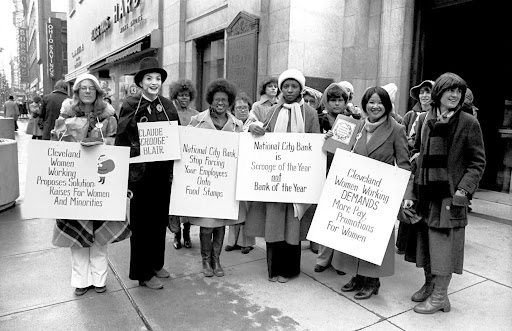
By 1978, for the first time in history, more women were employed in the paid workforce than were working exclusively in the home. Most were working out of necessity, as 43 percent of all women who worked were the sole breadwinners of their families. Yet women faced unfair policies and harassment and were overwhelmingly concentrated in the lowest-paying jobs: the average full-time female clerical worker earned $8,128 a year, compared to $12,843 for her male counterpart in the same role. At the nation’s most profitable bank, full-time clerical employees were eligible for food stamps; at a prominent insurance company, secretaries with 30 years of experience would retire on $110 a month.
The Working Women Education Fund (Norman grantee 1979–1984, 1991, 1995) was founded in Cleveland to build a national movement among the roughly 12 million women who had entered the workforce during the decade. Their goal was to establish workplace equality and dignity for women workers through a multi-pronged strategy that combined research, direct action, litigation, and media strategies. The Fund developed a replicable model that was shared across 35 states, pressuring banks, universities, and state attorneys general to address gender-based discrimination. In 1980, Jane Fonda’s film 9 to 5 — inspired directly by the experiences of its Cleveland members — brought women’s employment issues to a mass audience and helped fuel the organization’s growth. The Fund eventually became 9to5, which continues today as one of the leading organizations in the country advocating for economic justice for those most harmed by racism and sexism.
Media: